Make your browser game lighter without flattening its personality
I'd start asset optimization with the network panel, not a guess about which image looks large. The useful question is what the player has to download and decode before doing something interesting.
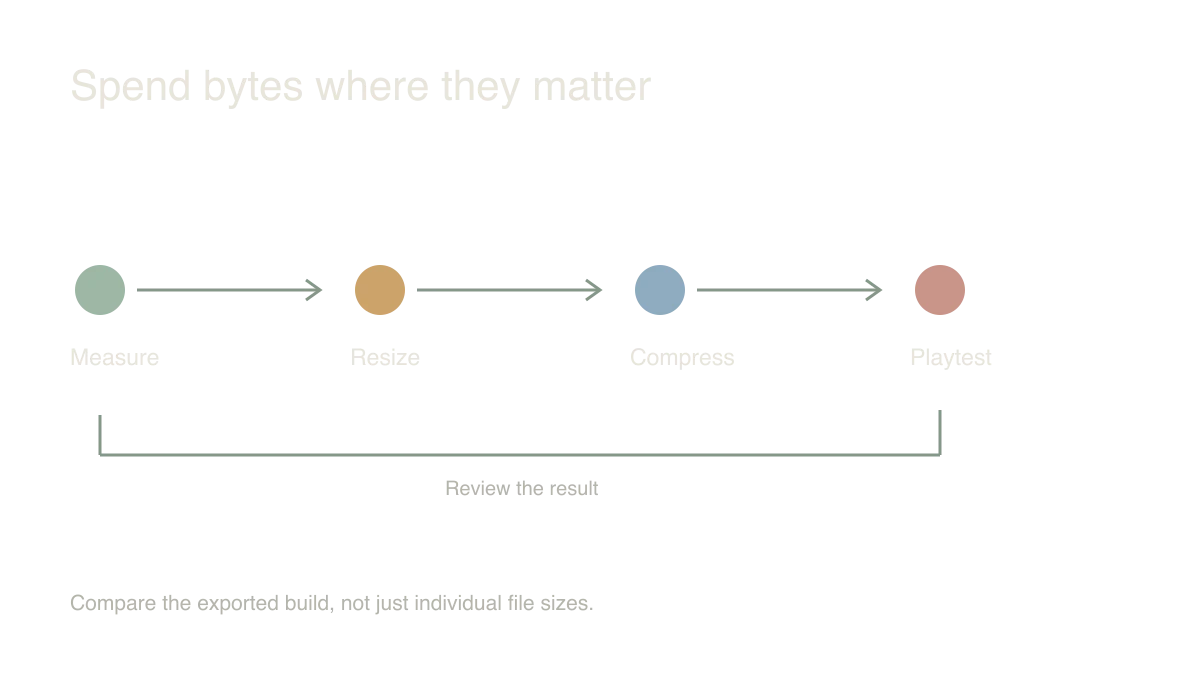
Measure the build you actually share
Open the hosted game with a fresh load and inspect its requests. Identify the largest assets and which ones block the first playable scene. Write down the current transfer sizes and loading behavior as your baseline.
Check more than images. Music, video and duplicated files can dominate a small game's download. An asset that never appears in the first scene may not need to arrive immediately.
I would fix one obvious expensive file first. That gives you a visible comparison and helps confirm that your measurements reflect the deployed build.
Match the asset to its job
Resize images for their real display needs. A huge source illustration may be useful for editing but unnecessary for a small in-game portrait. Keep the source separately and export the game version at an appropriate size.
Compare compression settings while looking at the asset in the game. Fine texture may tolerate a change that makes a small icon unreadable. Transparency edges and text baked into images need particular attention.
For audio and video, test the formats and settings your target environment supports. Listen and watch the exported result rather than assuming that a smaller file is an acceptable replacement.
Check memory and play, not just downloads
Compressed size and runtime memory are different measurements. A file that travels cheaply can still decode into a large image. Test on a representative device and look for stutters, slow scene changes or failed loads.
Play the same route before and after the change. Check that animation, sound timing and visual clarity survived. Keep the previous export so a bad optimization is easy to reverse.
I'd stop spending time on tiny savings while a much larger avoidable asset remains. The aim is a game that arrives and runs comfortably, with its important visual and audio cues still doing their jobs.
Sources and further reading
- Godot: importing images — accessed Sep 9, 2026
- Godot: exporting for the Web — accessed Sep 9, 2026
Make something of your own
Describe an idea and play it in minutes.
Create