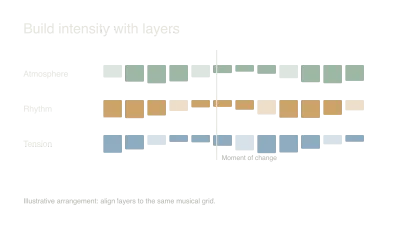
Make your game easier to hear by turning things down
When a game mix feels weak, adding volume is a tempting fix. I'd first decide which sound deserves attention. A useful warning needs space around it; making every layer louder usually leaves you with the same problem at a higher volume.
Give each group a job
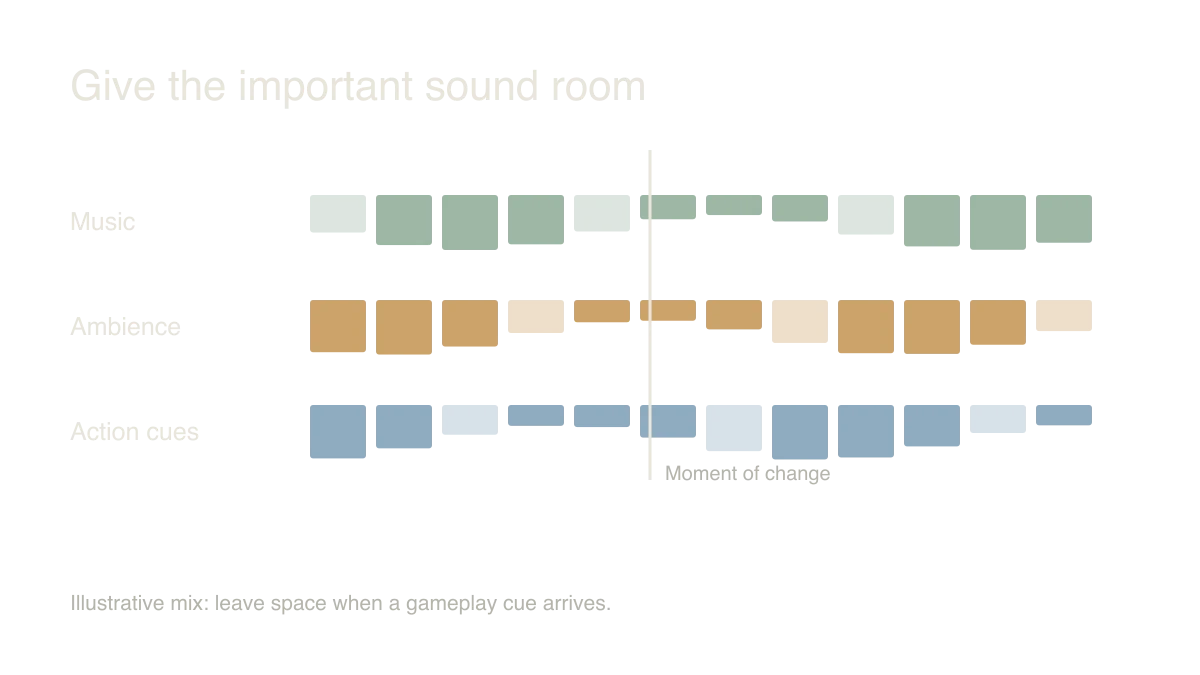
Separate music, ambience, gameplay effects and interface sounds into controllable groups. Start at comfortable levels and play a representative scene. Adjust while playing, because a mix that sounds balanced when idle may collapse during action.
Put essential information first. A danger cue should remain recognizable when music and repeated effects are active. Decorative ambience can sit much further back than it does in a standalone listening session.
I would also provide separate player controls for music and effects. Different listening environments and preferences are easier to accommodate when those decisions aren't tied to one slider.
Listen for collisions
Find the busiest moment you can reproduce. Trigger several rewards, an enemy action and a transition. Listen for sounds masking each other or stacking into a harsh burst.
Try reducing a competing layer before boosting the important one. Briefly lowering music around a key event can work, but avoid obvious pumping every time a common action happens.
Limit repeated effects where appropriate. Ten identical clicks at once don't necessarily communicate ten events better than a carefully controlled sequence. Keep any timing change consistent with what the player sees.
Test the whole session
Play through the opening, normal action, failure, restart and ending. Listen for abrupt cutoffs, music resetting too often and levels that drift between scenes. Test pause and resume as well as the happy path.
Check headphones and a small speaker at a modest listening volume. A cue built mainly from low bass may lose its identity on the smaller device. Add clarity through the sound's shape or higher-frequency detail rather than simply increasing its level.
Keep a short list of changes and compare one revision at a time. I'd stop when the player can understand the important events comfortably. A polished mix can be surprisingly quiet because the right sound arrives in the space it needs.
Sources and further reading
- MDN: Web Audio best practices — accessed Sep 9, 2026
- ElevenLabs: sound effects — accessed Sep 9, 2026
Make something of your own
Describe an idea and play it in minutes.
Create