Make AI tiles that survive being placed next to themselves
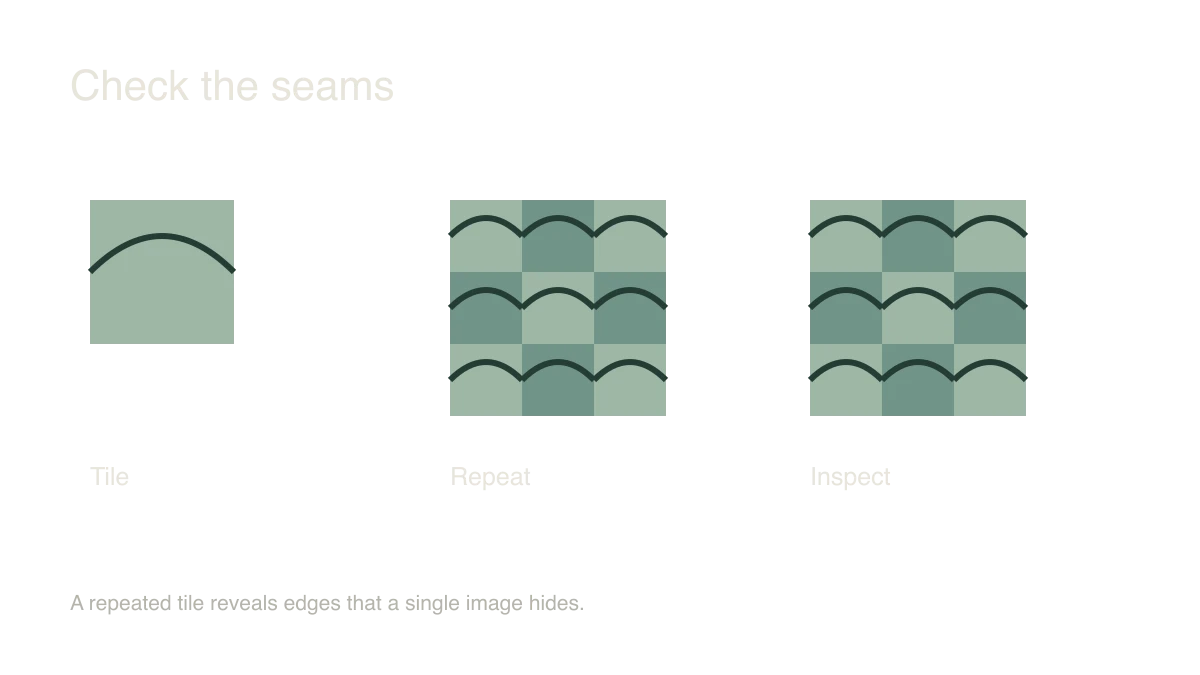
A single grass tile can look finished while a field made from it looks like a checkerboard. I'd repeat the first candidate immediately. Tiling is a relationship between edges, and an isolated preview hides that relationship.
Define the grid and view
Choose the tile size, camera view and intended game scale before generating. A top-down floor and an angled wall need different visual rules. Keep a small palette and lighting direction consistent across the set.
Start with a plain floor, a boundary and one transition. Those pieces tell you more about whether the set works than a folder full of decorative variants.
I would use a generated image as source material, then prepare the actual tiles deliberately. A prompt asking for a seamless tileset isn't a substitute for checking the exported edges.
Repeat before you expand
Place a candidate in a three-by-three grid. Look for bright borders, abrupt texture changes and a distinctive mark that becomes obvious every time it repeats.
Use an offset or wrap preview in your image editor to bring the outer seam into the middle, where it's easier to inspect and repair. Recheck the tile after editing; fixing one edge can create a new mismatch elsewhere.
Then place the floor beside its wall and transition pieces. They need a shared scale and visual weight, not just matching dimensions.
Build a room from the smallest useful set
Make one playable room and move the character through it. Check which surfaces read as walkable and whether boundaries are obvious without explanation.
Add variants only where repetition is distracting or the level needs a new connection. Keep the naming and grid placement predictable so the engine's tile tools remain manageable.
I'd also inspect the room at the camera zoom players will use. Fine generated detail can become noise when reduced, and a beautiful floor can compete with collectibles. The tileset is ready to grow when the room is easy to navigate and the repeated pieces stop calling attention to themselves.
Sources and further reading
- Godot: using TileSets — accessed Sep 9, 2026
- Godot: importing images — accessed Sep 9, 2026
Make something of your own
Describe an idea and play it in minutes.
Create