Give your AI coding assistant a target it can be checked against
A known target changes the conversation with a coding assistant. Instead of asking whether the result feels impressive, I can ask where its behavior differs from the reference. I'd borrow that discipline from a porting project even when building one original mechanic.
Write down observable behavior
Choose a small behavior: movement acceleration, a door trigger or a menu transition. Describe what happens for specific inputs, including the starting state and the result you expect.
For an original game, you can create a tiny reference implementation or a recorded design example. It doesn't need to be a finished commercial title. The useful property is that the target is concrete enough to compare with the generated implementation.
I would keep this reference independent of the code being changed. Otherwise the assistant can accidentally redefine success while rewriting the feature.
Reduce the comparison before expanding the port
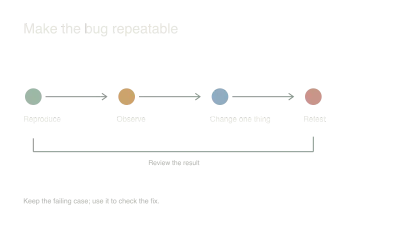
Build a scene that isolates the behavior. Fix the initial conditions and use a repeatable input sequence where possible. Observe the result, then change one part of the implementation.
For timing-sensitive behavior, record relevant values as well as video. Position, velocity and state transitions can help explain a difference that is hard to judge by eye.
Don't ask the assistant to fix movement, loading and rendering in the same patch. Separate boundaries make regressions easier to attribute and give you smaller changes to inspect or revert.
Inspect public projects as evidence
A repository with code and a playable link gives me more to investigate than a detached clip. The linked three-quake project is a useful starting point for that kind of investigation; it isn't a benchmark I have independently reproduced here.
Check the project's own README, history and licensing before drawing conclusions or reusing material. Code and game assets can have different terms, and a port's visible result doesn't reveal every hour of debugging behind it.
My takeaway is a method: a defined target, a small implementation step and a comparison you can repeat. I'd apply it to one difficult system first. An ambitious example is most helpful when it sharpens your working process, rather than persuading you to inherit its entire scope.
Sources and further reading
- mrdoob: three-quake repository and linked X dev log — accessed Sep 9, 2026
Make something of your own
Describe an idea and play it in minutes.
Create